Small Talk Made Easy: Openers, Follow-Ups & Exits

Small Talk Made Simple: A Printable Guide to Better Conversations and Everyday Social Skills
Small talk doesn’t have to feel forced or exhausting. With a few repeatable patterns—good openers, easy follow-ups, and graceful exits—everyday conversations can become simpler, more natural, and more enjoyable. A guide-focused approach helps reduce awkward pauses, build confidence, and turn quick chats into genuine connections at work, in social settings, and during daily errands.
Why small talk feels hard (and why it’s fixable)
Small talk often feels difficult because it stacks pressure on top of uncertainty. When there’s an unspoken expectation to “be interesting,” it can block the most useful skill in conversation: natural curiosity and listening.
Another common snag is not knowing what to say next. That uncertainty can lead to short answers, quick topic changes, or the dreaded stall where both people search for the next line. Add overthinking—tone, timing, “Did that sound weird?”—and the brain shifts into self-monitoring instead of connection.
The good news: small talk is a skill set, not a personality trait. A simple structure reduces mental load by giving you a predictable loop: open, reflect, ask, share—repeat.
A simple conversation framework: Open, Link, Ask, Share
When you have a reliable pattern, you don’t need perfect lines. You need a process that keeps the exchange moving while staying low-pressure.
- Open: Start with something present and neutral (setting, shared moment, context).
- Link: Connect to what the other person said with a brief reflection or paraphrase.
- Ask: Use a gentle question that invites detail without feeling like an interrogation.
- Share: Offer a small, relevant detail to balance the exchange and create warmth.
- Loop: Run the pattern 2–3 times, then either deepen the topic or exit politely.
Quick templates to keep conversations moving
| Step | What it does | Example lines |
|---|---|---|
| Open | Starts without forcing a big topic | “This place is busier than usual today.” |
| Link | Shows attention and builds comfort | “That sounds like a packed week.” |
| Ask | Invites a story or preference | “What’s been the best part so far?” |
| Share | Adds reciprocity and personality | “I’ve been trying to keep my weeks lighter—still learning.” |
| Exit | Ends warmly without awkwardness | “Good chatting—hope the rest of your day goes smoothly.” |
Easy openers that feel natural in real life
The best openers are simple and situational. They don’t demand a big answer; they give the other person an easy “yes,” a quick opinion, or a small detail to build on.
- Context-based openers: Comment on a shared environment—line speed, event vibe, weather shift, timing—without sounding rehearsed.
- Compliment the choice, not the person: “That’s a great book pick” lands more comfortably than commenting on appearance.
- Micro-observations: Small, low-stakes remarks invite quick agreement: “They always play good music here.”
- Add a soft question tag: “…right?” “…isn’t it?” “…have you noticed?” reduces pressure and keeps it friendly.
- Keep it light early: Avoid overly personal openers until you see signs of comfort (smiling, relaxed posture, longer replies).
Follow-up questions that don’t feel like an interview
Great follow-ups feel like curiosity, not data collection. The goal is to invite a little more detail while keeping the tone easy and optional.
- Choose “what” and “how” over “why”: “How’s that going?” tends to feel safer than “Why did you do that?”
- Use two-lane questions: “More of a coffee person or tea person—or neither?” creates an easy path to answer.
- Ask for a small recommendation: “Any favorite spot around here?” often produces quick, useful responses.
- Mirror and expand: Repeat one key word and invite detail: “A new role—how’s the transition been?”
- Try a 70/30 balance: Listen more than you talk, but share enough that the exchange feels mutual.
If listening feels hard when you’re nervous, a short refresher on the basics can help. Harvard Health Publishing breaks down why listening matters and how it supports connection: The power of listening.
What to say when the conversation stalls
Stalls happen even in good conversations. The difference is having a few “reset” moves that feel natural.
When stress is the main blocker, it helps to remember that the body can interpret social uncertainty as threat. For practical tools that reduce stress load, see Mayo Clinic’s overview of stress management: Stress management.
Gentle boundaries and graceful exits
Printable practice: turn social skills into a daily routine
Digital downloads to support better conversations
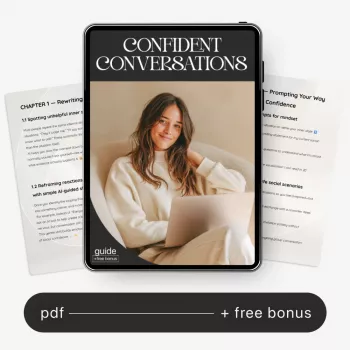
- Small Talk Made Simple | Digital Download Guide for Better Conversations, Easy Social Skills, Everyday Communication Tips, Printable eBook (quick reference pages for openers, follow-ups, and exits)
- Online-Dating Profile Blueprint | Printable Guide to Authentic Dating Profiles, First Messages, and Better Matches (useful when you want conversation to flow beyond “Hey, how are you?”)
- Your AI-Powered Daily Boost Checklist | Digital Energy Tracker, Productivity Planner, AI Wellness Tool, Daily Routine Optimizer Printable & Guide (a structured routine can lower daily stress and make social moments feel easier)
FAQ
How can small talk feel natural if social situations are stressful?
Keep the goal small: one friendly exchange using a short, neutral opener, then listen for one detail to link to and ask about. Practicing a few exit lines ahead of time also reduces the fear of being stuck, which often makes anxiety spike.
What are a few safe topics for small talk in most settings?
Try the immediate context (the place, the event, the line, the day’s pace), food or drinks, weekend plans, local recommendations, light entertainment, or a shared task. Save personal finances, health details, and polarizing topics for later—if at all.
How do you end a conversation without sounding rude?
Use a warm close, a brief true reason, and a good wish: “Nice talking with you—I’m going to head back in, but hope your afternoon goes great.” Ending on a positive note makes future conversations feel easier for both people.











Leave a comment