Printable Micro-Break Checklist for Quick Relaxation
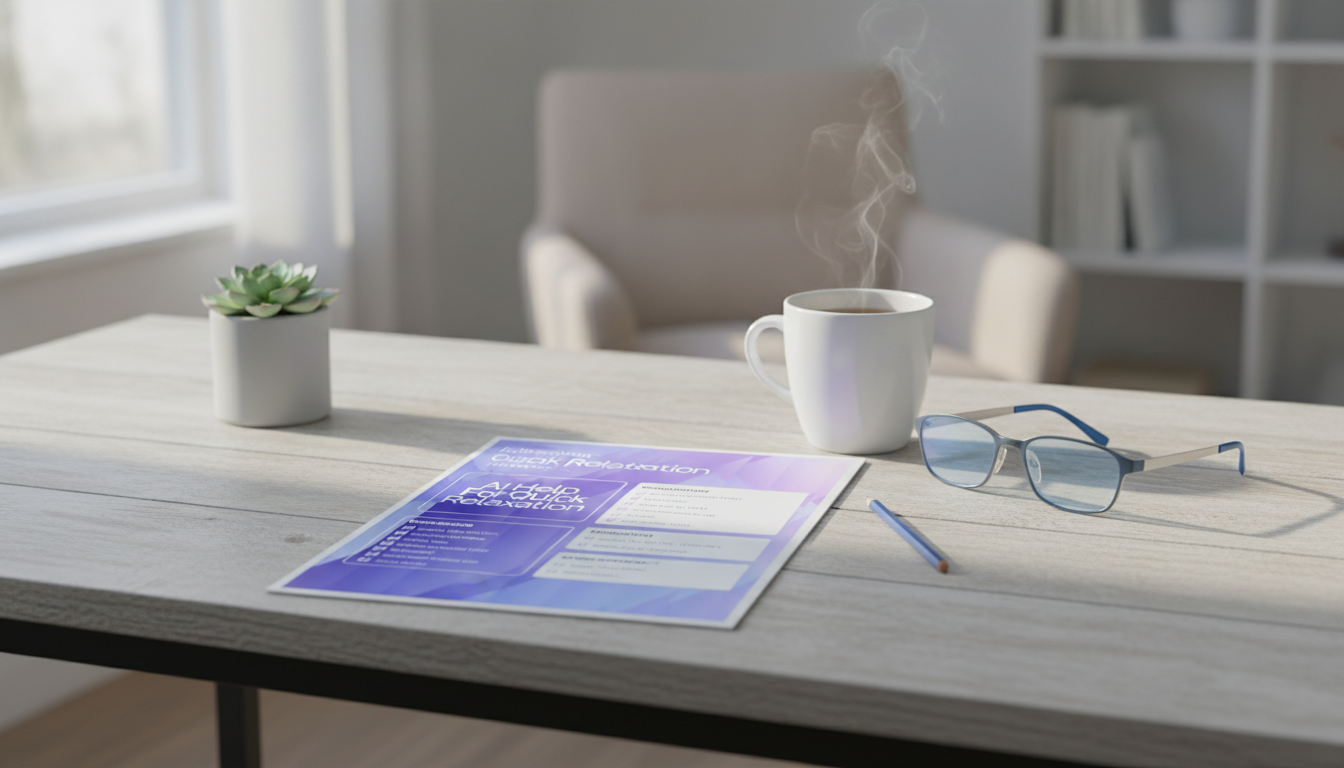
AI Help for Quick Relaxation: A Printable Checklist for Calm Living and Micro-Break Stress Relief
Busy days rarely leave room for long wellness routines. A short, repeatable micro-break can lower the intensity of stress in the moment and help reset focus—especially when it’s easy to follow and quick to print, save, and reuse. This guide explains how an AI-assisted relaxation checklist supports calm living, what to include in a guided micro-break routine, and how to make it work at a desk, at home, or on the go.
What “quick relaxation” looks like in real life
A micro-break is a brief pause (often 30 seconds to 5 minutes) used to interrupt stress buildup and reduce mental overload. It’s not a full reset of your day—it’s a small pressure release that helps you keep going with fewer sharp edges.
- Keep it specific: one action for the body (release tension), one for breathing (slow the system), and one for attention (re-anchor in the present).
- Lower the volume, don’t chase zero stress: the goal is to feel just steady enough to think clearly and continue with less strain.
- Use a checklist to reduce decision fatigue: when the next step is already chosen, it’s easier to follow through—especially when you’re already overwhelmed.
How AI support helps short relaxation routines stick
Short routines work best when they’re easy to repeat and easy to adapt. AI-style support (even something as simple as rotating guided options) helps you avoid the “What should I do right now?” spiral.
- Personalization: choose a routine based on time available (60 seconds vs. 3 minutes), setting (office vs. commute), and preference (breathing vs. muscle release).
- Variety without complexity: rotate between a few micro-break options so it feels fresh while staying consistent.
- Consistency cues: a visible checklist on a desk, inside a planner, or saved to your phone can nudge a calm reset before stress escalates.
- Progress without pressure: checkmarks can reveal patterns (like late-afternoon tension or meeting fatigue) without turning relaxation into another performance metric.
For a quick, ready-to-print option, the AI Help for Quick Relaxation printable checklist is designed around short windows and real-life pacing—so you can start with the smallest version and still feel a shift.
Guided micro-break routine for stress relief (2–4 minutes)
This quick sequence is intentionally simple. If you try to fix everything at once (breathing, posture, thoughts, emotions), your attention splinters. Pick the next step and stay with it.
- Step 1 (20 seconds): Name the moment. Silently label what’s happening (for example: “tight shoulders,” “racing thoughts,” “overstimulated”).
- Step 2 (60–90 seconds): Breathing reset. Inhale gently through the nose, then exhale longer than the inhale. Repeat several cycles at a comfortable pace.
- Step 3 (30–60 seconds): Release one tension point. Drop shoulders, unclench jaw, or relax hands—choose only one area to avoid multitasking.
- Step 4 (30–60 seconds): Re-orient attention. Notice 3 things you can see, 2 you can feel, 1 you can hear; end by choosing the next single task.
Optional (10 seconds): Add a boundary line: “Next, I will do one small step,” then begin.
For more background on why stress affects the body (and why small calming actions can help), see the American Psychological Association’s overview of stress effects on the body.
Printable checklist: what to include for calm living
A good checklist turns “I should relax” into a tiny, concrete plan. The best formats are short enough to use daily and flexible enough to fit different moods and settings.
Micro-break options by time and setting
| Time available | At a desk | On the go | Before sleep |
|---|---|---|---|
| 30–60 seconds | Shoulders down + 3 slow exhales | Relax jaw + feel feet on the ground | Hand on chest + slow exhale focus |
| 2–3 minutes | Breathing reset + neck release | Grounding: 3-2-1 senses scan | Gentle breathing + body scan (head to toes) |
| 4–5 minutes | Mini stretch + eyes-away break + water | Short walk + steady exhale pacing | Light stretch + screen-free wind-down |
If you’d like a structured way to track energy and pace your day (not just calm down in the moment), Your AI-Powered Daily Boost Checklist pairs well with micro-breaks by helping you notice when your focus and energy dip.
When to use a micro-break (so it prevents spirals)
For more practical relaxation ideas you can mix into a checklist, the Mayo Clinic’s relaxation technique guide offers accessible options you can adapt to short breaks.
Making the routine feel natural (not like another chore)
What’s inside the printable checklist product
Find it here: AI Help for Quick Relaxation | Printable Checklist for Calm Living.
A simple weekly plan to build calmer momentum
FAQ
How long should a micro-break be for stress relief?
Most micro-breaks fall between 30 seconds and 5 minutes. Consistency matters more than duration, so when time is tight, choose the shortest option rather than skipping the break.
Can breathing exercises help if the mind won’t slow down?
Yes—especially when you focus on longer exhales and one simple body cue (like dropping your shoulders). Try a gentle inhale and a slightly longer exhale for several cycles, keeping the breath comfortable rather than forced.
Is a printable checklist better than using an app?
A printable checklist is often more visible and lower friction, with fewer notifications competing for attention. Apps can work well too—the better choice is the one you’ll actually use consistently in the moments you need it.







Leave a comment